Use cases
A day running a solo physio practice on Movari
From the first appointment to the last invoice, what a working day actually looks like on Movari.
By Stephen Thomas · · 5 min read
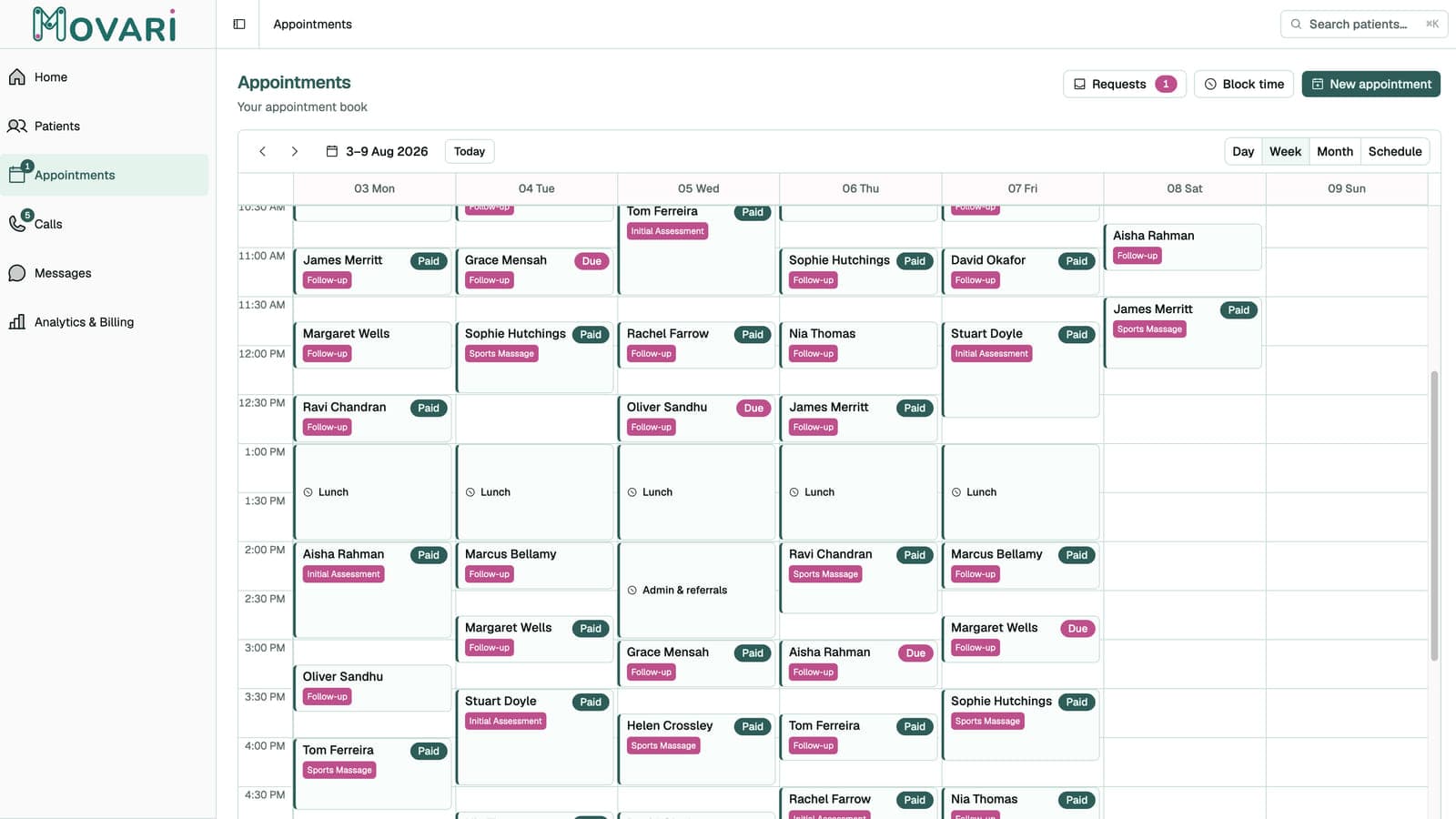
Feature lists are a poor way to judge software you are going to live inside for eight hours a day. What matters is the shape of the day: how many times you switch tools, how much admin piles up for the evening, and how often you have to think about the software instead of the patient.
So here is a working Tuesday, start to finish.
08:10, before the first patient
You open Movari. The home screen is not a dashboard of charts; it is a short list of things that need you. This morning it is three items: a voicemail from overnight, one online booking request waiting for a decision, and an unpaid invoice from last week.
The voicemail came in at 21:40. You did not get a call at 21:40, because the practice number goes straight to voicemail by design, and your personal phone stays yours. What you have instead is a transcript, a one-line summary, and a badge saying the caller is not an existing patient. New enquiry, wants to know if you treat plantar fasciitis. Thirty seconds to read, and you tap the number to call back on your way in.
The booking request is for Thursday at two. You recognise the name, the slot works, you confirm it. The patient gets a confirmation email with the time, the address you typed, and your practice name on it, not Movari's.
09:00, first patient
New patient, first appointment. Their intake form is already done: they filled it in from a link you sent when the booking was confirmed, so you have their history, their medication list, the safety screening answers, and their agreement to your terms sitting in the record before they walk in.
Because it is a new patient, you take a proper subjective history. The note is SOAP-structured, so you are typing into Subjective, Objective, Assessment and Plan rather than into a blank box that will be hard to read in two years. You mark up a body diagram for the areas involved.
You leave the note as a draft. It stays editable all day.
09:40, the plan
Before they leave you build their exercise programme. Four exercises, and you set the sets, reps and frequency for each. Two of them you have prescribed a hundred times, so they come out of a template.
You send the link. There is no app for them to download and no account to create: they open it on their phone, and if they want, they add it to their home screen where it behaves like an app. When you change their programme in three weeks, the same link shows the new one. Nothing to resend, nothing for them to lose.
They pay on the way out: you send a payment link, they tap it, done. Or they pay by card in the room, or they do not pay today and it sits on their account. Your rules, set once.
11:00, the one that overruns
Existing patient, complicated. They mention something that changes the picture, and the appointment runs fifteen minutes over.
This is the moment that decides whether software is on your side. In Movari you drag the next appointment later in the diary; you get a confirmation dialog showing the old time and the new one, because an accidental drag that silently emails a patient a new time is not a small mistake. You confirm. The patient gets the update.
13:30, admin, but briefly
Over lunch you clear the morning's notes. Three drafts, and you lock them. Locked means locked: the record is now fixed and anything further goes on as a dated amendment that shows who wrote it and when. That is the whole point: a clinical record you could hand to a solicitor or a regulator without wincing.
You also deal with the messages. Two came in overnight: one on WhatsApp asking to move an appointment, one on Instagram from someone who found you through a post. Both are in the same inbox, next to the clinical records, rather than on your personal phone at 22:00. You reply to both. The one about moving an appointment gets saved into that patient's record, because it is clinically relevant. The Instagram one does not, because it is not.
Neither of them talked to a bot. If a message had arrived out of hours, they would have had one automatic reply (the exact sentence you wrote, saying when you are next open), and that is all.
16:45, the last patient does not turn up
No show. You mark it as such. About two hours later the patient gets an email that states the actual charge that ended up on their account, including "no charge has been applied" if you waived it, because announcing a fee you then decide not to charge is worse than saying nothing.
17:30, you stop
There is no evening admin session, and that is the actual claim of this article. Not that any single feature here is revolutionary: plenty of software has a diary and plenty has notes. It is that the notes, the diary, the payments, the exercise programme, the phone and the messages are the same product, so nothing needs re-typing into a second system and nothing gets forgotten in the gap between two.
The bit you would notice most if you went back is the phone. Not having to decide whether to answer an unknown number between patients, and still not losing the enquiry, changes the texture of a day more than any feature I could put on a comparison table.
This is all handled for you on Movari.
Request early access