How it works
Exercise prescription patients actually do
What makes the difference between a home exercise programme that gets done and one that doesn't, and what Movari does about it.
By Stephen Thomas · · 4 min read
Adherence to home exercise programmes is famously poor. The figures vary by study and by condition, but the direction is consistent and unflattering: a large proportion of what we prescribe is never done as prescribed, and a meaningful proportion is not done at all.
The interesting question is not why are patients lazy, because mostly they are not. It is: what specifically goes wrong between the room and the living room?
Having watched this from both sides (as a patient for two years, and now building software for it), I think it comes down to four failures, and only one of them is about motivation.
Failure one: they cannot remember what you meant
You demonstrated it. They watched. They nodded. Forty minutes later they are at home holding a resistance band with no idea whether their elbow was tucked in or out.
A sheet of line drawings does not fix this, because the thing that was hard to remember was the movement, and a drawing is not a movement. A video helps considerably. A video with a voice explaining what to feel and what to avoid helps more, because the failure mode is usually not "wrong exercise", it is "right exercise, wrong compensation".
For some movements even video is not enough: you cannot see the pelvis from the camera angle that shows the knee. That is where a 3D model earns its place: the patient rotates it and looks from behind. Not a gimmick, just the ability to answer what is supposed to be moving without you in the room.
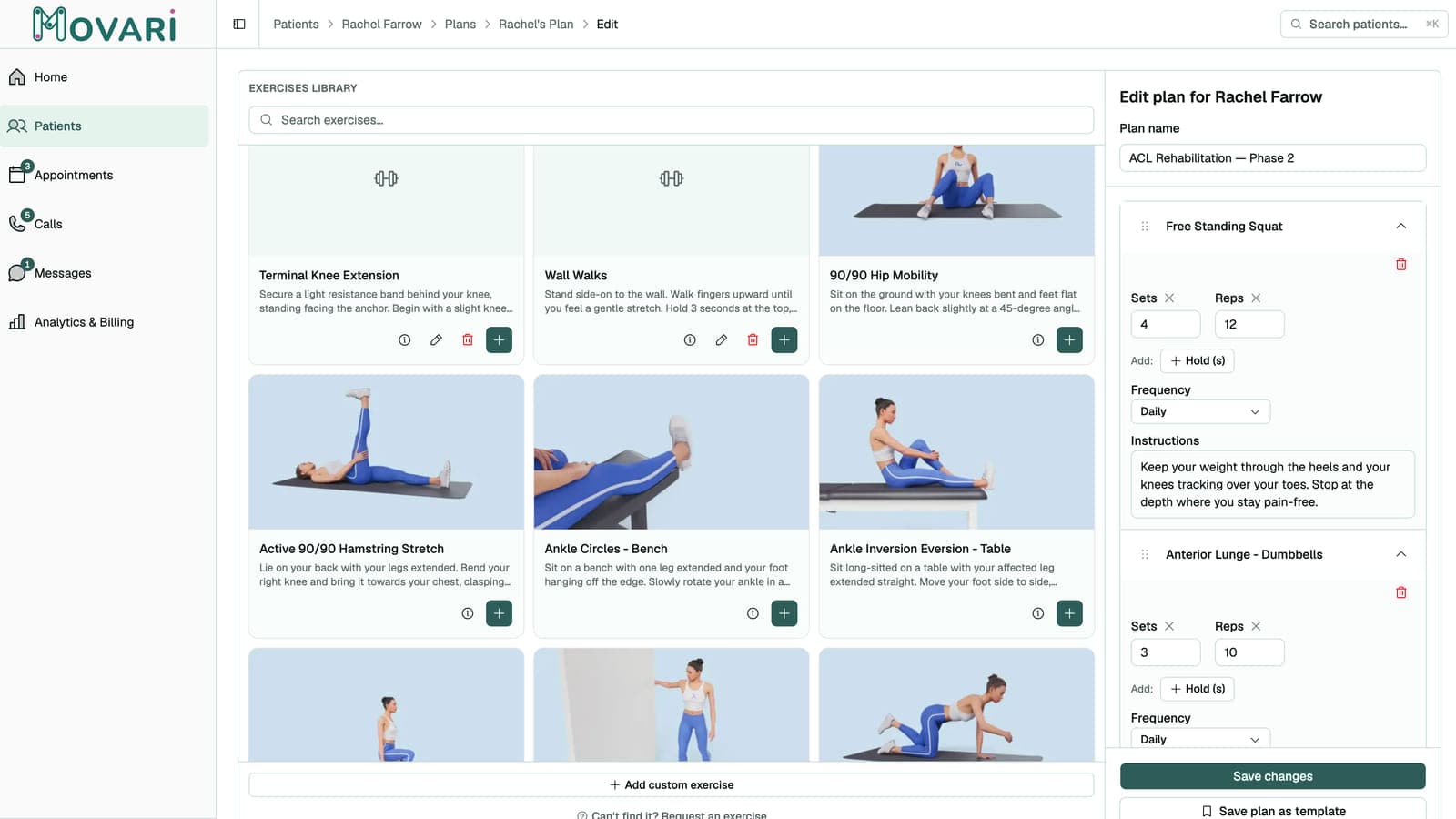
This is why Movari includes an exercise library with controllable 3D models, voiceover and video, rather than expecting you to buy that separately from someone else. Which brings me to the second failure.
Failure two: the friction of getting to it
If the exercise programme lives behind a login, adherence drops. This is not a controversial claim; it is the most reliable finding in the whole area. Every step between the patient and the exercise costs you some percentage of the people who will do it.
An app to download is a big step. An account to create is a big step. A password to remember three weeks later is where the whole thing quietly dies.
So Movari has none of those. The patient gets a link. They open it. That is the entire flow. If they want it on their home screen it behaves like an app once they put it there, but that is their choice, not a prerequisite.
There is a second-order benefit that took me a while to appreciate: because the link is stable, updating the programme requires nothing of the patient. You change it, and the next time they open the same link, it is the new one. No resend, no "did you get my email", no version confusion where they have been doing last month's exercises for a fortnight.
Failure three: you prescribed too much
This one is on us, collectively.
Eight exercises, three times daily, is a programme that looks thorough on paper and gets abandoned by Thursday. The patient does not tell you they abandoned it. They tell you "yeah, I've been doing them", because they like you and they feel guilty, and now your clinical reasoning is running on false data.
There is no software fix for this. It is a prescribing decision, and the honest version is that three exercises done is worth more than eight prescribed. What software can do is make it cheap to change your mind. If adjusting the programme takes ten seconds and requires nothing of the patient, you are far more likely to cut it down at the next appointment instead of leaving an unrealistic plan in place because editing it is a faff.
Failure four: nobody ever looks
If a patient does their exercises for six weeks and nobody ever mentions it, the exercises feel optional. If they do not do them and nobody notices, they definitely are.
Movari gives patients a single tap to mark a session done. Not a diary, not a pain score every day, not a streak with a flame emoji. One tap. That deliberately low bar is the point: anything more elaborate gets abandoned along with the exercises.
What you get is a quiet signal on their record. There is no notification, no alert, nothing that turns adherence into another inbox you have to clear. It is simply there when you open the patient before their next appointment, so you can walk in already knowing whether to ask "how did you find them?" or "what got in the way?".
Those are different appointments. Being able to tell which one you are walking into is worth more than any amount of adherence dashboard.
The uncomfortable summary
Most of what determines whether a home exercise programme works is decided in the room, by you, in the ninety seconds where you choose how much to give and how well you explain it.
Software cannot prescribe better than you. What it can do is stop being the reason a good prescription fails: by removing the login, killing the password, making the movement legible without you there, and letting you adjust in seconds rather than avoiding it because the tool makes it tedious.
That is a smaller claim than most exercise platforms make. It is also, I think, the true one.
This is all handled for you on Movari.
Request early access