How it works
Why your patients will never talk to our chatbot
Because there isn't one. Movari's automatic replies send the exact sentence you wrote, and here is why we think that's the right call.
By Stephen Thomas · · 5 min read
Every software category is currently being fitted with a chat assistant, whether or not anyone asked. Practice management is no exception, and the pitch is always the same: it handles your enquiries so you don't have to.
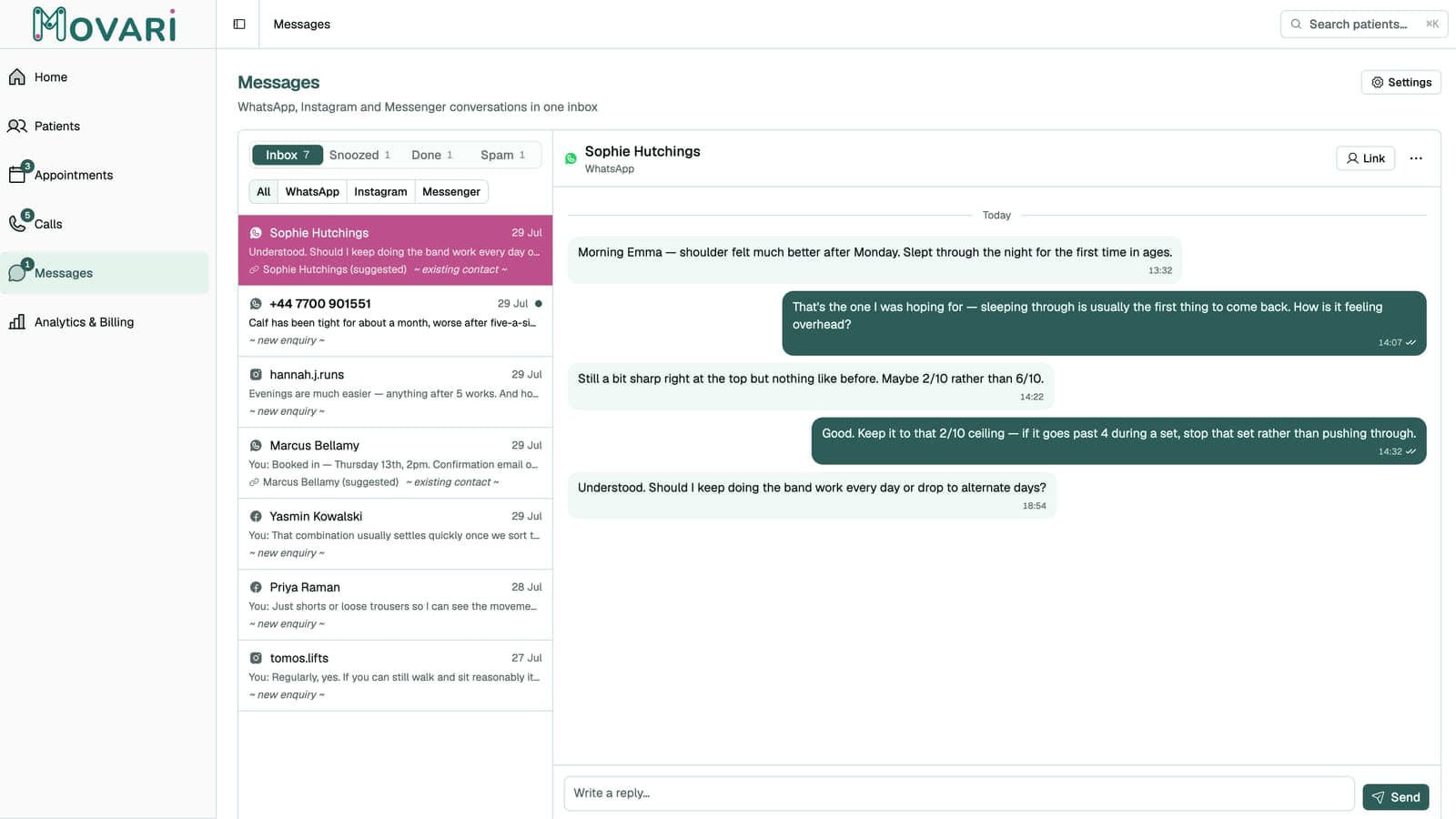
Movari has patient messaging: WhatsApp, Instagram and Messenger in one inbox next to the clinical record. It has automatic replies. It does not have a chatbot, and it is not going to get one by accident.
This is the reasoning, because I think the reasoning matters more than the feature.
What the automation actually is
Two rules. Both off until you turn them on.
First-contact greeting. Someone messages you for the first time. They get one reply.
Out of hours. A message arrives outside the times you have set. They get one reply.
That is the whole feature. And the reply is not generated: it is the exact sentence you typed into a box, sent verbatim. If you write "Thanks for getting in touch, the clinic is closed at the moment and I'll come back to you when we're next open", that is precisely what arrives. Not a paraphrase, not a variation, not something a model produced that morning.
Why not generate the reply?
Because the failure mode is catastrophic and the upside is small.
A generated reply to a patient message is, structurally, an unsupervised clinical conversation. Someone messages your practice at eleven at night describing chest pain that they think is a muscle strain. A well-behaved model gives a reasonable, hedged, useful-sounding answer. That is the good outcome, and it is still an unqualified entity giving health guidance under your practice's name, at an hour when you cannot see it happening.
The bad outcomes are worse and do not need spelling out.
Set against that: what does the generated version buy? A slightly more natural sentence acknowledging a message you are going to answer properly in the morning anyway. That is not a trade I want to make on your behalf, and it is definitely not one to make silently.
Patients can tell, and they mind
There is also a plainer argument. Nobody enjoys talking to a bot when they are trying to reach a person about their body.
If someone messages a physiotherapy practice, they are not browsing. They are in pain, or worried, or trying to sort something out. A conversational agent that keeps them talking without resolving anything is a worse experience than a short, honest message saying received, closed now, back to you tomorrow, because the second one is true and sets an expectation they can act on.
The single-line automatic reply is not a lesser version of a chatbot. For this situation it is the better product.
The guardrails, since they are the interesting part
One reply per inbound message, never two. If a message qualifies as both first contact and out of hours, the out-of-hours reply wins and the greeting is suppressed.
Once per closed period, not a rolling timer. If someone messages you five times between Friday evening and Monday morning, they get one automatic reply for the whole weekend. A rolling cooldown would send a robotic acknowledgement every few hours to someone who is clearly trying to reach a human, which is the exact behaviour that makes people hate automated messaging.
It never touches your triage. The thread stays unread. It is not marked handled, it does not move out of your inbox, and nothing about it suggests the conversation is dealt with. The automatic reply buys the patient an expectation; it does not buy you a cleared inbox.
Threads you have marked as spam never get one. No point announcing your opening hours to a bot selling SEO services.
It is never attributed to you. An automatic message shows as Automatic reply in the thread, appears as Auto: rather than You: in the inbox list, and if the conversation is later saved into a clinical note, the line is attributed to "Automatic reply" and not to you. That last one matters most: a clinical record must never imply you personally said something a machine sent while you were asleep. It is enforced in the database, not just in the interface: the app physically cannot write a message attributed to automation from your session.
What we deliberately did not build
Keyword rules. The obvious next feature: if the message contains "cancel", do this. We cut it. Literal string matching has no connection to anything else the system knows, and it decays into maintaining lists of synonyms and word endings forever. It looks clever in a demo and becomes a liability in a year.
Automatic sorting of your inbox. Movari does not read your patient messages to categorise or prioritise them. Triage is manual: you look, you decide, you snooze or you are done. Sorting would mean sending the content of patient conversations to a language model to answer a question (is this a new enquiry or an existing patient?) that you can answer instantly by reading the name. That is not a good trade with someone else's medical information.
Anything outbound. No campaigns, no broadcasts, no reactivation sequences. It is an inbox, sitting next to the clinical record. That boundary is written into our own product documentation specifically so that a future version of me cannot quietly cross it.
The summary
The automation in Movari is deliberately dull: two rules, one sentence each, written by you, sent verbatim, clearly labelled, at most once.
It gets patient enquiries off your personal phone, sets an honest expectation when you are closed, and leaves the actual conversation to you. In a category busily bolting language models onto medical correspondence, doing less here is the considered position rather than the roadmap not having got there yet.
This is all handled for you on Movari.
Request early access